Royal Guards changing the Guard in Amalienborg, Copenhagen, Denmark.
Even in snowstorms and heat waves, the Royal Life Guards devotedly keep watch at their shield houses at Amalienborg Palace, keeping a watchful eye on the royal family. The historical roots of the Life Guards date back to 1658 and they have been stationed next to Rosenborg Palace since 1785. The shield houses in their present form can probably be dated back to 1740, when they were used in front of Christiansborg Palace.
From Rosenborg, the guards march daily from the barracks towards Amalienborg, where they relieve their comrades at 12 o’clock. The parade passes through the city – often accompanied by a music corps – and attracts large crowds of spectators. The whole thing has something of a fairy tale about it… The uniform of the Life Guards, with its bearskin cap, has evolved over 300 years; the characteristic blue pants, for example, have been worn since 1822.
Parade and changing of the guard come in different forms: King’s Guard, Lieutenant’s Guard and Palace Guard. The King’s Guard is the most extensive form and takes place when HM Queen Margrethe II is at Amalienborg Palace. During the Palace Guard, no member of the Royal Family is staying at Amalienborg at the time in question. The regent couple lives in Christian IX’s palace, the crown prince couple in Frederik VIII’s palace, while HRH Prince Joachim and Princess Marie as well as HRH Princess Benedikte use Christian VIII’s palace, which also houses the museum, for representation purposes. However, not only the extent of the changing of the guard, but also the use of various flags indicates which member of the royal family is currently at Amalienborg. One must pay attention to whether the royal flag, the flag of the heir to the throne, the imperial administrator flag or the royal house flag is flying above the black roofs of Amalienborg. When only the double pennant is hoisted, no one from the royal family is in the palaces of Amalienborg at the moment.
We visited the Edertalsperre to see one of the famous dams in Germany.
The Edertalsperre and Edersee is a well visited place in Germany for over hundred years. It is surrounded by a lot of camping sites, youth hostels and small hotels.
For more videos please visit and subscribe our YouTube Channel
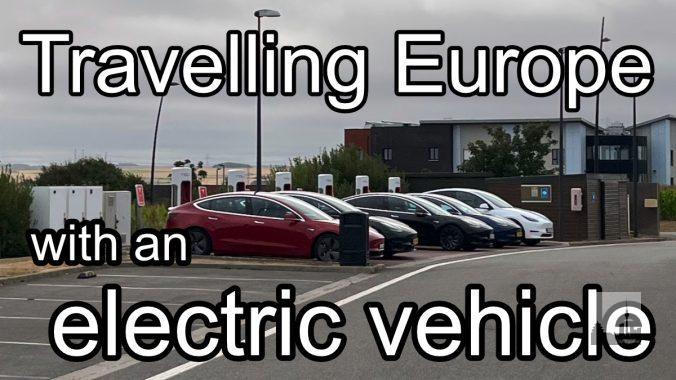
Travelling with an electric vehicle (EV), especially longer trips, seems to scare a lot of people. We went on our first long trip to see for ourselves.
Estimated reading time: 5 minutes
The planned route was Netherlands to Belgium to Paris and later on we decided to add Switzerland to the list.
We drive a Tesla Model 3 which has – compared to other electric vehicles – the advantage of the Tesla Superchargers. We get back to this point later because it did affect our experience in a positive way.
Netherlands
Using an EV in the Netherlands is easy. There are thousands of charging points in the cities. Even in parking garages you can find a lot of chargers. For example: Rotterdam City Centre alone has around 1000 charging points. Amsterdam and Utrecht are counting more than 3000 chargers in the city and the near area.
Due to the smaller size of the country, travelling from one city to another does not take long. Charging at the next destination is nothing to worry about. Also, the speed limit helps a lot to save energy which can be crucial on longer trips.
It is pretty safe to say, using an electric vehicle in the Netherlands is not a big deal at all.
Charging Points in Belgium
In Belgium it is a bit different. There are a lot of AC chargers, but mostly with just 2 charging points. It is neither easy to find a free spot nor are they clustered in parking garages like in the Netherlands. On our way to Ghent we stopped at a gas station on the motorway where Fastned had built a station approximately 50m away.
Despite the quantity of chargers available in Belgium, we couldn’t find one in the city centre of Ghent without using an app like Chargemap. Same situation in Bruges.
Don’t get me wrong here, we never had to worry about charging, but we didn’t find it as convenient as in the Netherlands, where, if you want to visit a place, park your car and a charger is right there.
All critique aside, Belgium is still easy to travel with an electric vehicle.
Electric vehicles in France
Travelling through France is another story. This country is so much bigger and the distances between destinations are mostly so long that service stations are needed.
Every bigger service station seems to have charging points and Tesla builds Superchargers at every one of them.
Why am I bringing this up?
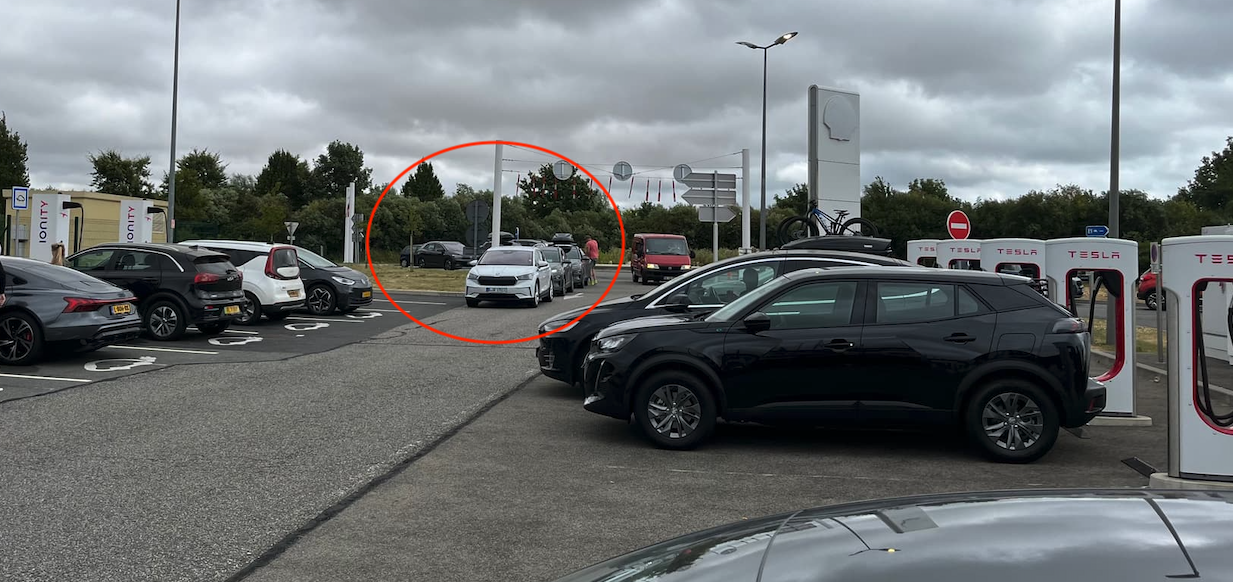
The charging points are there but they are just not enough. We stopped at Aire de la Baie de Somme and fortunately we were able to use the Superchargers because there are also 5 more Ionity chargers where around 15 cars were waiting in line into the roundabout traffic.
Cars queue up to get a spot at the charging station
As you can see in the example above, this is currently the biggest problem with electric mobility. It’s not the missing places where you can charge your car, it’s the missing effort to provide enough spots at certain times of the day, week or year.
Tesla Supercharger (12 Stalls, red) – Ionity Charger (5 Stalls, blue) – Apple Maps
Thanks to Tesla’s Superchargers, on the 3000+ km trip we have been on, we have not even had to wait once to plug in and charge. If you don’t drive a Tesla it is possible to use Superchargers on selected locations. Might be a bit pricey, but not waiting in line for an hour or more might be worth it, especially on vacation trips.
Charging in Paris
Our next stop was Paris. You can see a lot of EVs here and it seems that people kind of thought that through. You can find easy access charging stations next to parking lots on bigger streets. As you can see on the screenshot below, those parking lots are reserved for customers and where mostly free.
Charging Points, with reserved parking in the streets in Paris – Google Maps
Our trip went very well and at no point was there any problem with charging our car. Everything was doable and we always arrived relaxed and safe at our destination. Using apps like ChargeMap or Bonnet is definitely a must, otherwise you will get lost in bigger cities, especially when you don’t know how the local charging stations look like.
To clear one thing up: the brand of your car doesn’t matter. Driving a Tesla was – as mentioned above – a big plus on the long distances because Superchargers are very reliable and always come in higher numbers. Hence waiting time reduces from a few minutes to none. That being said, I think it is worth downloading the Tesla App and check out the conditions and locations for using Superchargers for non-Tesla cars.
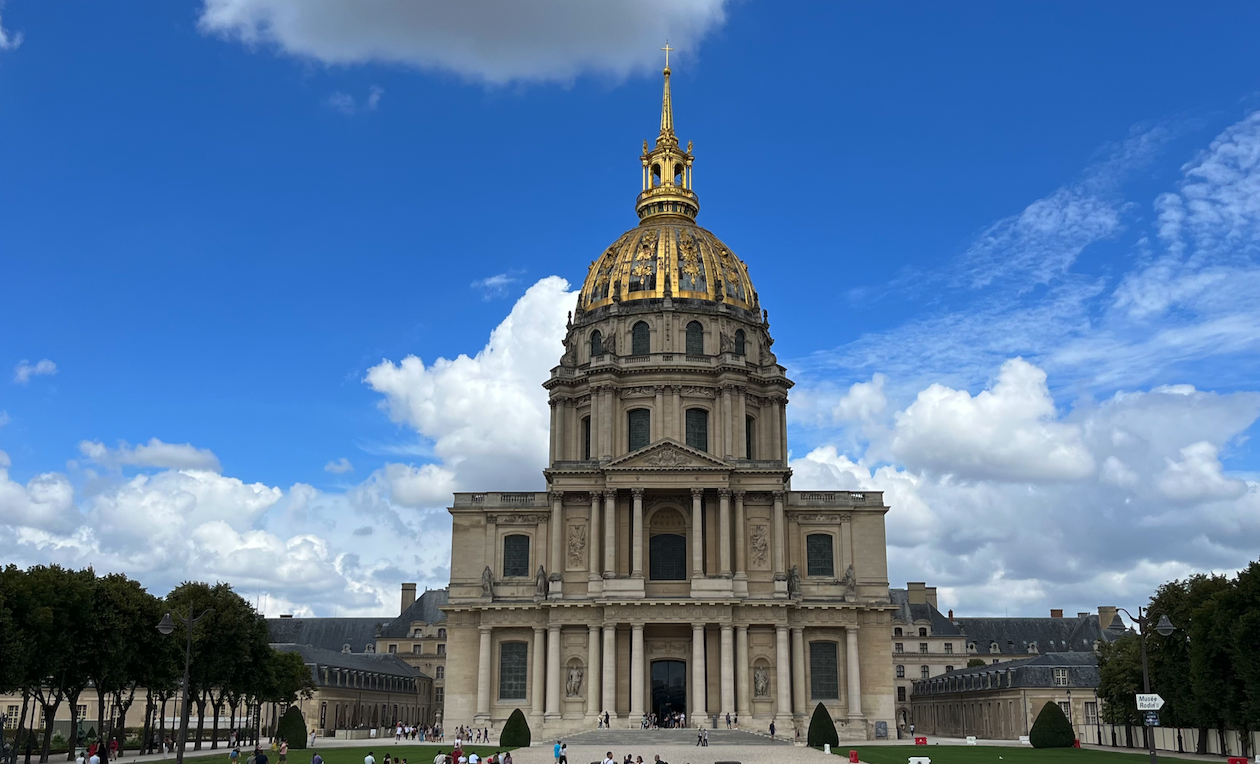
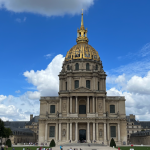
Hôtel des Invalides, Jardin des Tuileries and Notre-Damehave been on our must see list on day 2 of our journey through Paris.
Estimated reading time: 6 minutes
There is so much to see in Paris. With just one full day in this beautiful city we made a rough plan of where we wanted to go so we could be able to enjoy the city by walking from sight to sight.
We started from hotel La Bourdonnais (as mentioned in the previous post) which is a perfect starting point in Paris and walked to the Hôtel des Invalides. We picked up some water and snacks on the way and arrived there within 15 minutes. Basically a walk around the corner.
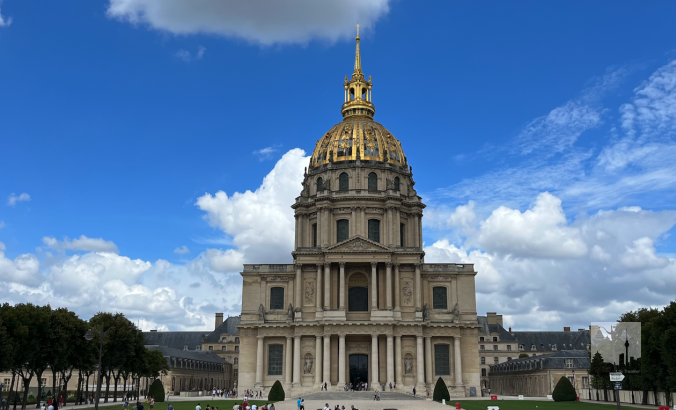
Hôtel des Invalides
Hôtel des Invalides, Avenue de Tourville, 75007 Paris
The Boulevard des Invalides lead us to the Place des Invalides which gave us an impressive view at the Hôtel des Invalides. In the other direction along the Avenue du Maréchal Gallieni was the stunning Pont Alexandre III.
Place des InvalidesPont Alexandre III
Fortunately, trees cover the park on both sides of the Avenue du Maréchal Gallieni, so that we had the opportunity to have a snack and avoid the heat a little bit. 🥵
We crossed the bridge to the Grand Palais and the Petit Palais. Unfortunately, the Grand Palais was closed due to construction.
Along the Champs-Élysées to the Louvre
Walking the Champs-Élysées with hundreds of tourists gave us a glimpse of how popular Paris is. Either they come from or are going to the Place de la Concorde which was our next destination, too.
Champs-Élysées
After crossing the Place de la Concorde and entering the Jardin des Tuileries the noise turns from “cars, busses and scooters” to “(a lot of) people taking a walk”.
There are places with benches, chairs and some tables between the trees where you can sit and relax. There is none of the rush of this big city, so you can walk calmly through the gardens and enjoy the scenery.
We took a little break under the trees in front of the Arc de Triomphe du Carrousel, a place pretty crowded with people looking for shelter from the sun.
Arc de Triomphe du Carrousel
Next to the Arc there is a food truck which provides sandwiches, fresh waffles and cold drinks. So, if you are not prepared with food and drinks, you can recharge yourself pretty well here.
As we crossed the Place du Carrousel to the Louvre, we could already see the line of people waiting for tickets. We expected a lot of people would be there and didn’t really plan on getting a ticket, but it was a bit disappointing anyway.
The Louvre
We decided to keep exploring Paris and went along the Seine to see the Musée d’Orsay. With time ticking down we didn’t even think about going in, but we put it on the list for our next visit.
Bridges of Paris
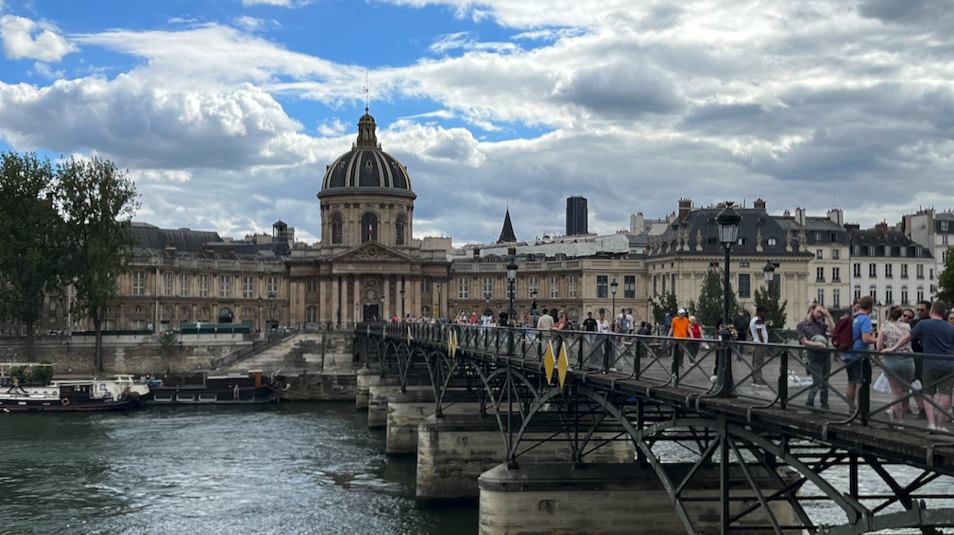
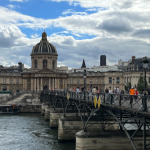
Heading east, crossing Pont Royal and enjoying our way along the Seine to the Pont des Arts. From here you have a great view on the Académie des Beaux-Arts.
Pont des Arts
After crossing the Pont des Arts we took a turn on the Quai Du Louvre and crossed the Seine once again on Pont Neuf. For a short break we turned into a street with a building that turned out to be the Palais de Justice which was closed due to constructions.
On the opposite site of the street there is Place Dauphine which is a nice little park with benches, restaurants and cafes. Away from tourists and loud streets, locals were having snacks and enjoying themselves playing games of boule. It was like a little hideout in the middle of Paris.
Notre-Dame
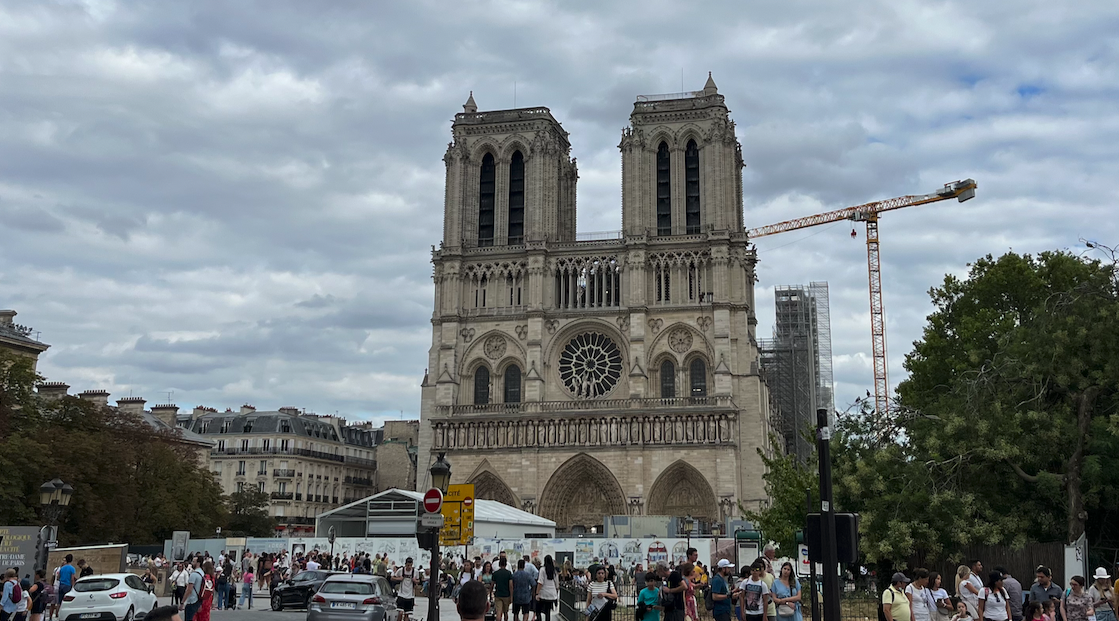
We went on to the Cathédrale Notre-Dame de Paris which – after the fire on 15 April 2019 – is still a construction site. Containers and fences are still blocking the view which does not stop the thousands of people streaming on and off the square every day.
Notre-Dame
The Rue Du Petit Pont lead us in the direction of our hotel and at the Saint-Séverin we turned into a small alley which lead us through postcard-like-Paris.
Walking the streets of Paris
After arriving at the hotel a few hours later – with very sore feet and legs – one things was clear: we need to come back to Paris and visit all the other great places we couldn’t see on that one day. 🥰
Those were two very exhausting and exciting days and we need way more time to enjoy all the sights and places.